The e-invoicing UAE mandate is no longer a future consideration. The Federal Tax Authority (FTA) and Ministry of Finance have set a structured rollout that starts with a pilot phase in July 2026 and moves to mandatory compliance from January 2027 for businesses with annual revenue above AED 50 million. Smaller businesses follow in the phases after that.
For finance heads and decision makers, the more pressing question is not when, but how. What does e-invoicing implementation actually involve, what needs to change inside your existing ERP or accounting software, and where do things typically go wrong? This post covers all of it.
What E-Invoicing in UAE Actually Means for Your Business
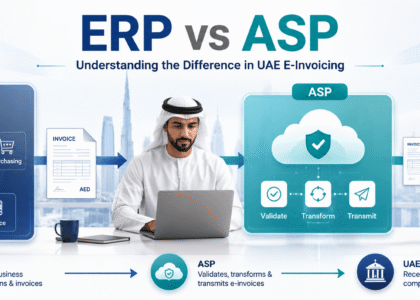
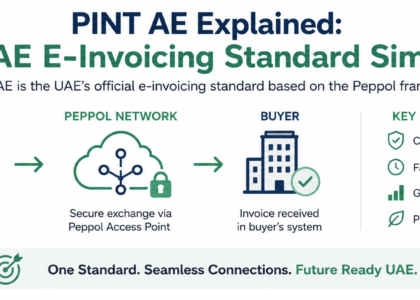
A PDF invoice emailed to a buyer is not an e-invoice under the UAE framework. Under the FTA mandate, every tax invoice must be generated in PINT-AE XML format, a structured, machine-readable standard that carries specific data fields the FTA can read and validate automatically. That XML file does not go directly to your buyer either. It travels through your Accredited Service Provider (ASP), gets validated against FTA rules, and the transaction data is reported to the FTA in near real-time before the invoice completes its journey.
The UAE has adopted a Decentralised Continuous Transaction Control and Exchange (DCTCE) model, operating on a 5-corner network through Peppol. Corner 1 is your system, Corner 2 is your ASP, Corner 3 is the buyer’s ASP, Corner 4 is the buyer’s system, and Corner 5 is the FTA’s tax data reporting layer. Every invoice moves through all five. If your system cannot produce PINT-AE XML or connect to a Peppol-accredited ASP, none of this works.
UAE E-Invoicing Requirements Businesses Must Meet Before the 2027 Deadline
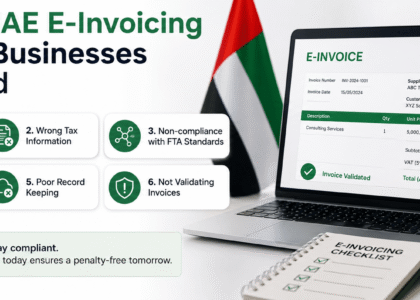
Before getting into implementation, it is worth being clear on what a compliant invoice actually needs to contain. This is the output your system must produce every time.
A compliant UAE PINT-AE XML invoice must include:
- Supplier and buyer details including Tax Registration Number (TRN)
- Unique invoice reference number and issue date
- Description, quantity, and unit price of each line item
- Applicable discounts and net amounts
- VAT rate and VAT amount per line
- Total invoice value including VAT
- Cryptographic stamp applied post-validation by the ASP
UAE e-invoicing applicability is structured by revenue and phased by business size. Phase 1 covers businesses with annual revenue above AED 50 million, with Phase 2 bringing in smaller businesses from July 2027. UAE tax invoice requirements apply across B2B, B2G, and G2B transactions, and free zone businesses are included unless specifically excluded. Non-compliance carries penalties of up to AED 5,000 per month, making early readiness a financial decision as much as a technical one.
The FTA Has Made Amendments in UAE E-Invoicing Deadline: What the Current Timeline Looks Like
The rollout timeline has shifted more than once. Originally the ASP appointment deadline for Phase 1 businesses was set at 31 July 2026. The Ministry of Finance extended this to 30 October 2026 following an assessment of market readiness and business feedback on the need for more competitive pricing and wider technical options. The mandatory go-live date of 1 January 2027 has not moved.
| Milestone | Phase 1 (AED 50M+ revenue) | Phase 2 (below AED 50M) |
| Pilot phase (voluntary) | 1 July 2026 | 1 July 2026 |
| ASP appointment deadline | 30 October 2026 | 31 March 2027 |
| Mandatory go-live | 1 January 2027 | 1 July 2027 |
That extension to October 2026 is not a signal to delay. A proper integration between your ERP or accounting software and an FTA-approved ASP takes weeks, sometimes longer if master data is inconsistent, invoice mapping is complex, or your software needs configuration work before it can output PINT-AE XML. Businesses that treat October as their start date will be scrambling.
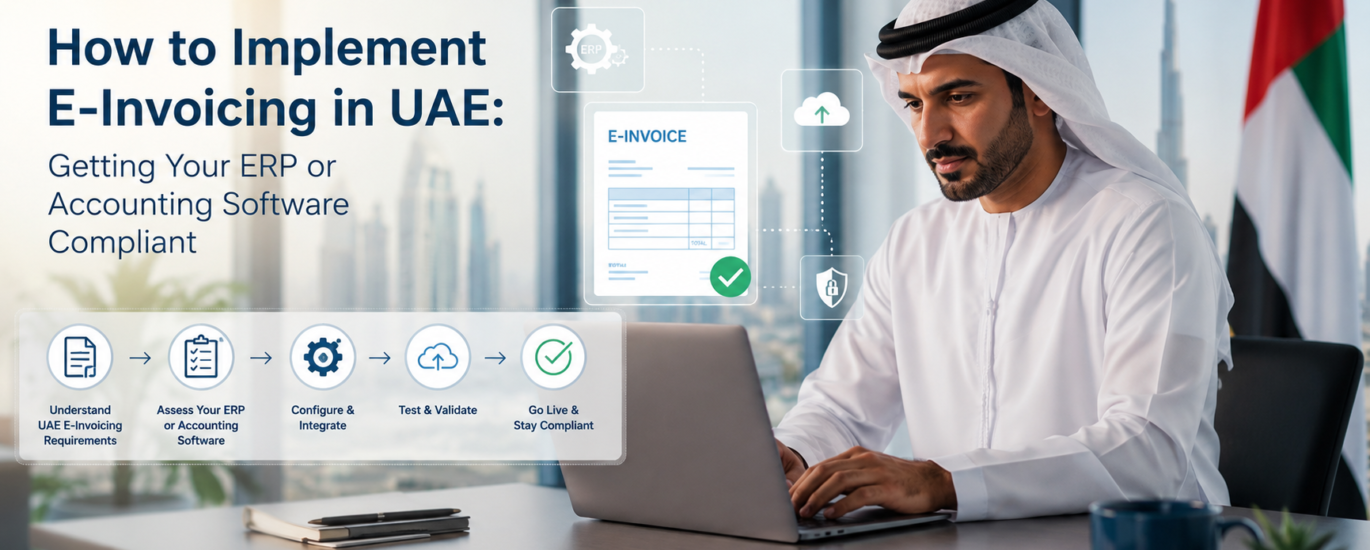
How E-Invoicing Implementation Works: Step by Step
Here is what the process looks like in practice. The steps are the same whether your business falls under Phase 1 or Phase 2, though the urgency differs considerably.
Step 1: System assessment
Start with an honest look at what your current ERP or accounting software can produce. The two questions that matter: can it generate PINT-AE XML output, and does it support the API connectivity your ASP needs to receive and transmit that data? Most systems used by UAE businesses were not built with this in mind. Some can be configured. Others cannot, and the sooner you know which camp you are in, the better.
Hitech Innovations runs this assessment at the start of every client engagement. It is the only way to give a business a realistic scope and timeline rather than discovering problems mid-integration.
Step 2: Choosing the right integration path
The assessment points you toward one of three paths. Here is how they differ:
| Scenario | Applies to | Typical effort |
| API integration with existing software | SAP, Oracle, Odoo, QuickBooks, Sage | Medium: 4-8 weeks depending on data complexity |
| Built-in e-invoicing module | Zoho Books, Tally (own UAE modules) | Lower: configuration and compliance verification |
| Software replacement | Legacy or heavily customised systems that cannot produce XML or support API connectivity | High: plan for 3+ months minimum |
On the API integration path, Hitech handles the data mapping, API configuration, and end-to-end testing. For Zoho Books and Tally users, both platforms have their own UAE e-invoicing modules, but configuration and compliance verification against FTA rules is still needed and often skipped. For businesses on legacy systems, the conversation about replacement is better had now than when a deadline is weeks away.
Step 3: Data mapping and configuration
This is where most implementation projects hit unexpected delays. Every field in your invoice, supplier TRN, buyer TRN, VAT line items, discount logic, currency handling, has to land in exactly the right position in the PINT-AE XML schema. Master data that looks clean in your ERP often turns out to have gaps or inconsistencies when mapped against the schema requirements. Customer records missing TRNs, products without commodity codes, rounding differences in VAT calculations: these surface during mapping, not after go-live if you test properly.
Hitech Innovations works through this mapping systematically with each client, identifying data gaps before they become compliance gaps.
Step 4: Testing
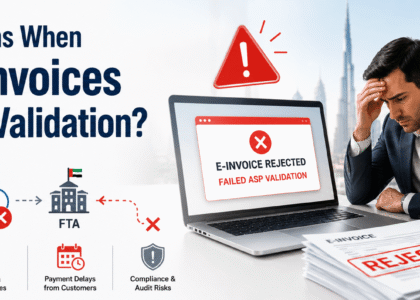
The FTA platform has a test environment for a reason. Before going live, invoices need to complete the full 5-corner journey in a sandbox: your system generates the XML, your ASP validates it, the FTA data layer receives the reporting copy, and the stamped invoice comes back. Failures at this stage are common, usually in VAT calculation rounding, missing mandatory fields, or API timeout handling. Finding them here is straightforward. Finding them after go-live when live invoices are rejected is not.
Step 5: Go-live and handover
Go-live is not the end of the project. Your finance team needs to know what a rejected invoice looks like in your system, what triggers a resubmission, and who handles it. The 5-year archival requirement under Federal Decree-Law No. 8 of 2017 also kicks in from day one, so your document storage and retrieval process needs to be ready. Hitech provides a structured handover covering all of this before sign-off.
Why Work With an FTA-Approved ASP Partner Like Hitech Innovations
Every UAE business must connect to the FTA e-invoicing platform through an Accredited Service Provider. You cannot do this independently. Hitech Innovations has partnered with an FTA-approved ASP, which means the full implementation sits within one engagement: system assessment, PINT-AE XML mapping, ASP connectivity, testing, and go-live.
For finance heads managing this alongside everything else, the practical value is a single accountable team across the whole process. No separate vendor relationships to manage, no integration handoffs between parties who do not talk to each other. Hitech handles it end to end with a defined scope, timeline, and clear escalation when things need resolving.
Frequently Asked Questions
Which businesses does UAE e-invoicing apply to?
Any business conducting taxable transactions in the UAE, regardless of VAT registration status, falls within scope, with B2C transactions currently excluded. Timing depends on revenue. Businesses above AED 50 million go first, with an ASP appointment deadline of 30 October 2026 and mandatory go-live from 1 January 2027. Smaller businesses follow with an ASP deadline of 31 March 2027 and go-live from 1 July 2027. Government entities are last, from 1 October 2027.
Can I integrate e-invoicing with my existing accounting software?
In most cases, yes. Whether your system is Odoo, SAP, Oracle, QuickBooks, Sage, or something custom built, the integration path depends on whether it can already generate structured PINT AE invoices, needs configuration to do so, or requires a separate integration layer connecting it to an Accredited Service Provider. This is exactly what the implementation steps above cover.
What if my current software is not compatible with e-invoicing?
If your system can’t be configured or extended to produce structured XML invoices, you have two options: add a middleware layer that handles the PINT AE formatting and ASP connection on top of your existing software, or migrate to a system with native e-invoicing support. Which makes sense depends on how old your current system is and how much custom logic is built into it, something a readiness assessment identifies early rather than mid-project.
For the full compliance timeline, penalties, and business-size breakdown, see our e-invoicing ERP integration service page. For a deeper look at the technical standard, see PINT AE explained. For what an ASP actually does, see Accredited Service Provider in UAE e-invoicing.
Get your e-invoicing implementation started before the deadline
Whether your Phase 1 ASP appointment deadline is October 2026 or your mandatory go-live is January 2027, the implementation work takes longer than most businesses expect. ERP mapping, data cleanup, API configuration, and testing cannot be rushed without creating compliance risk.
Hitech Innovations works with finance teams across the UAE to assess their current systems, manage the integration with an FTA-approved ASP, and ensure everything is tested and live before it needs to be.
Talk to Hitech Innovations about your e-invoicing implementation