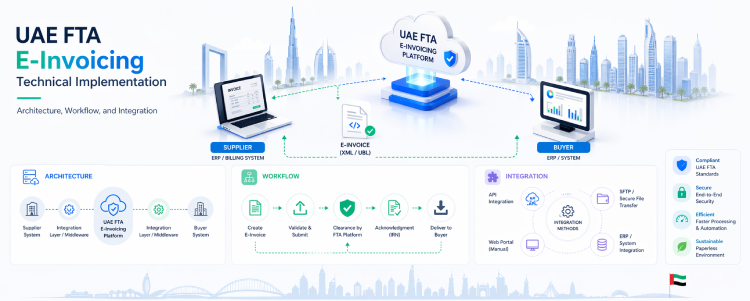
The UAE Federal Tax Authority (FTA) e-invoicing framework represents a fundamental shift from document-based invoicing to structured, machine-readable financial data exchange. This transition requires ERP systems to operate within a regulated digital ecosystem where invoices are no longer static documents but validated data objects that must conform to predefined regulatory schemas before transmission.
Unlike traditional invoicing models, where documents are generated, exchanged, and validated retrospectively, the UAE framework introduces real-time validation and structured interoperability across ERP systems, integration layers, and external compliance endpoints. This changes the role of enterprise systems from transactional record-keeping tools into active compliance enforcement engines.
From a technical standpoint, this evolution impacts ERP architecture design, API communication strategy, data governance models, and financial process automation. It requires businesses to move toward structured data generation, secure system-to-system communication, and validation-led processing workflows embedded directly into the invoicing lifecycle.
The implementation approach is therefore built on three foundational principles:
- Standardised data transformation from ERP-native formats into structured schemas
- Secure API-based communication across internal and external systems
- Multi-layer validation to ensure compliance before regulatory submission
Technical Implementation Architecture for UAE E-Invoicing
The UAE e-invoicing architecture is designed as a controlled interoperability framework connecting ERP systems with compliance infrastructure. It ensures that invoice data is transformed from internal business records into structured, validated digital tax documents before being exchanged externally.
At a functional level, the architecture operates across three key layers:
- ERP Source Layer: Invoice generation and transactional data capture
- Processing Layer: Data transformation, validation, and routing logic
- Compliance Layer: ASP networks and regulatory communication
Each layer performs a distinct control function to ensure that only validated, schema-compliant invoices are transmitted outside the organisation.
A core architectural principle is pre-submission validation, where invoices must meet structural and tax requirements before leaving the ERP environment. This reduces rejection rates, improves data accuracy, and strengthens compliance at the source.
End-to-End E-Invoicing Transaction Flow
The UAE e-invoicing transaction flow follows a structured, event-driven lifecycle where every invoice moves through defined validation and transmission stages.
The process begins within the ERP system when a business event such as a completed sales order, service delivery, or billing trigger generates an invoice. At this stage, the data exists in ERP-native formats designed for operational processing rather than regulatory compliance.
This data is then mapped into a canonical format to standardise invoice structure across systems. This step is essential for maintaining consistency in multi-entity or multi-ERP environments.
Once standardised, the invoice enters a controlled processing pipeline:
- Conversion into UAE-compliant XML or JSON schema
- Validation against regulatory business rules and VAT logic
- Verification of mandatory fields such as tax identifiers, timestamps, and line-level details
- Assignment of unique invoice identifiers for traceability
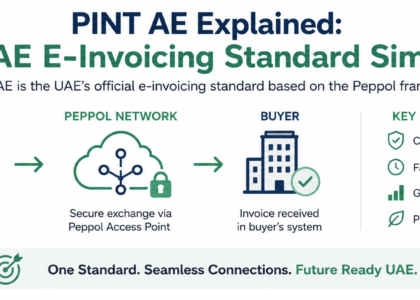
After validation, the invoice is transmitted through secure APIs to an Accredited Service Provider (ASP) or access point, which acts as a certified intermediary within the e-invoicing network. The ASP performs additional compliance checks, ensures correct routing to the recipient’s system, and facilitates regulatory reporting where required.
Once processed, a validation or delivery status is returned and synchronised back to the ERP system. This enables real-time tracking, reconciliation, and audit readiness.
This creates a closed-loop system where every invoice has a fully traceable lifecycle from creation to final status.
Core Technical Requirements
UAE e-invoicing compliance depends on strong alignment between ERP systems, integration layers, and regulatory data standards. These requirements define how invoice data is generated, validated, transmitted, and stored.
Structured Data Standardisation (XML/JSON)
Invoices must be generated in machine-readable formats aligned with UAE-defined schemas. XML supports strict hierarchical validation, while JSON enables lightweight data exchange across API-based environments.
Consistent field-level mapping across ERP systems is essential to ensure interoperability, reduce validation errors, and maintain data integrity across the invoice lifecycle.
API-Based Communication Framework
E-invoicing systems rely on APIs to enable seamless communication between ERP platforms, ASP networks, and external endpoints.
Core API capabilities include:
- Real-time exchange of invoice data between ERP systems, ASP platforms, and recipient networks
- Structured payload transmission aligned with UAE-defined XML or JSON schemas
- Immediate validation response handling, allowing ERP systems to process acceptance or rejection without delays
- Submission control mechanisms to prevent duplicate or inconsistent invoice reporting
- End-to-end visibility of invoice status across validation, routing, and delivery stages
Auditability and Data Traceability
Every invoice transaction must be fully traceable across its lifecycle to meet regulatory and audit requirements.
Systems should maintain immutable logs capturing:
- Invoice creation timestamps
- Transformation and validation history
- Transmission and response status
- Error and exception records
This ensures complete transparency, supports audit readiness, and enables accurate reconciliation of financial data.
Exception Handling & Compliance Controls
Exception handling is a critical component of UAE e-invoicing, ensuring that validation failures do not disrupt overall operations.
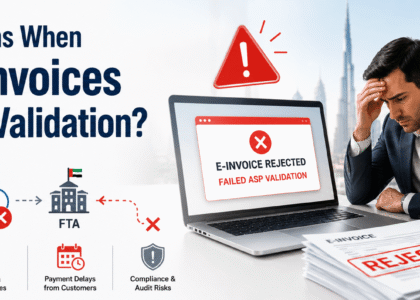
When an invoice fails validation, it is automatically classified based on the type of error, such as schema non-compliance, incorrect tax data, or missing mandatory fields.
These exceptions are managed through controlled workflows rather than manual intervention. Each failed invoice is routed to a structured correction cycle where issues are identified, resolved, and revalidated before resubmission.
To maintain operational continuity, invoice processing is designed to be non-blocking. Valid invoices continue through the pipeline, while failed transactions are isolated and tracked separately. This ensures that compliance issues do not interrupt billing processes.
A key requirement is maintaining full traceability of all exception scenarios. Every correction, validation attempt, and status update must be recorded, creating a transparent audit trail for regulatory review and internal compliance monitoring.
Integration Options for UAE E-Invoicing
Integration architecture defines how ERP systems connect with the UAE e-invoicing ecosystem. The selected approach impacts scalability, compliance management, and long-term system efficiency.
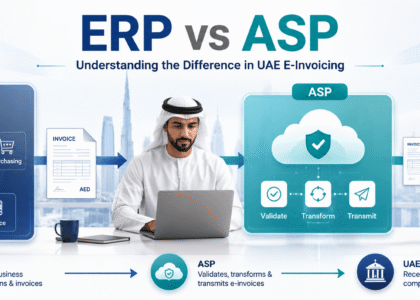
In the UAE model, integration is primarily centred around Accredited Service Providers (ASPs), which act as certified intermediaries between businesses and the broader e-invoicing network.
ASP-Based Integration
Accredited Service Providers (ASPs) manage the exchange of invoice data between ERP systems, trading partners, and regulatory infrastructure.
They are responsible for:
- Validating invoice data against required schemas and tax rules
- Managing secure transmission across the e-invoicing network
- Handling regulatory updates and compliance requirements
- Providing status responses for tracking and reconciliation
This model reduces internal technical complexity while ensuring continuous alignment with evolving compliance standards.
Choosing the Right Integration Approach
While ASP integration forms the foundation, organisations must decide how their ERP systems connect to these providers.
The choice depends on:
- ERP system capability to generate structured invoice data
- Complexity of system landscape (single vs multi-ERP environments)
- Transaction volumes and performance requirements
- Internal capability to manage validation and data transformation
A well-defined integration strategy ensures smoother implementation, lower compliance risk, and better scalability as regulatory requirements evolve.
Implementation Timeline for Businesses
UAE e-invoicing implementation follows a structured engineering lifecycle rather than a traditional software deployment process.
Discovery Phase
ERP systems, invoice workflows, and data structures are analysed to identify compliance gaps. This phase directly connects with Part 02 readiness assessments.
Configuration Phase
ERP systems are configured to support structured invoice generation, tax logic mapping, and mandatory field enforcement aligned with FTA requirements.
Integration Phase
Systems are connected to middleware, ASP platforms, or regulatory endpoints. API authentication, payload mapping, and secure transmission channels are configured.
Testing Phase
End-to-end validation is performed across multiple scenarios:
- Successful invoice processing
- Schema validation failures
- Exception handling workflows
- High-volume stress testing
Go-Live Phase
Invoices begin flowing through the production environment with continuous monitoring for system stability, compliance accuracy, and exception rates.
How UAE Businesses Should Start Preparing Now
Preparation for UAE e-invoicing requires alignment across ERP systems, data governance, and integration strategy. Technical readiness is directly dependent on the quality and consistency of upstream financial processes.
Organisations should begin with a structured ERP capability assessment to evaluate whether existing systems can generate compliant, structured invoice data and support integration with external e-invoicing networks.
Master data standardisation is a critical priority. Customer, supplier, and tax-related records must be consistent and validated to prevent errors that can lead to invoice rejection during processing.
Rather than focusing only on integration models, businesses should define how invoice data will flow from ERP systems into the e-invoicing network, ensuring that validation, transformation, and transmission steps are clearly mapped and controlled.
Technical Readiness Checklist
- ERP supports XML or JSON structured invoice generation
- Integration capability is available to connect with ASP or access point networks
- Tax fields and master data are standardised and validated
- Audit logs are maintained for full invoice traceability
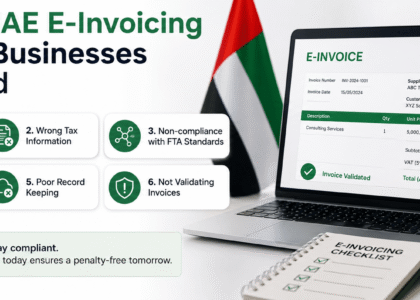
- Exception handling workflows are clearly defined
- End-to-end testing capability is in place
Finance teams must also be prepared to operate within a compliance-driven environment. This includes understanding validation outcomes, managing rejected invoices, and ensuring accurate reconciliation between ERP systems and external confirmations.
At this stage, it is also important to align preparation with broader transformation initiatives. You can revisit foundational concepts in our guide on ERP readiness for UAE e-invoicing to assess system capability in more detail. For regulatory context and expected timelines, refer to understanding UAE e-invoicing deadlines, which outlines key compliance milestones.
Conclusion: Building a Compliant and Scalable E-Invoicing Foundation
UAE e-invoicing represents a structural transformation from document-centric invoicing to real-time structured financial data exchange. It requires alignment between ERP systems, integration architecture, and regulatory compliance frameworks.
The regulatory foundation phase defined the compliance mandate, including timelines, enforcement direction, and Federal Tax Authority expectations shaping nationwide adoption. The enterprise readiness phase focused on evaluating ERP capability, improving master data quality, and ensuring internal processes are capable of supporting structured invoicing requirements. The technical execution phase brings these elements together by defining how systems, integrations, and data workflows must operate to enable compliant invoice processing at scale.
Organisations that approach this transition as a financial data engineering initiative rather than a conventional system upgrade will achieve stronger scalability, reduced compliance risk, and improved audit readiness.
Before implementation begins, businesses should first conduct a structured technical assessment to evaluate whether their ERP systems, data quality, and integration architecture are ready for e-invoicing requirements. Based on this assessment, they should then define a phased implementation roadmap that guides system configuration, integration, testing, and go-live in a controlled and compliant manner aligned with UAE FTA requirements.
Frequently Asked Questions on UAE FTA E-Invoicing Technical Implementation
1. What is the technical architecture used for UAE e-invoicing?
UAE e-invoicing architecture is built on a structured data exchange model that connects ERP systems with validation layers and external compliance endpoints. It ensures invoices are generated in a machine-readable format, validated for accuracy, and transmitted securely for regulatory compliance. The architecture also includes audit logging and exception handling to maintain full traceability across the invoice lifecycle.
2. How does the end-to-end e-invoicing flow work in UAE systems?
The process starts when an invoice is generated in the ERP system based on a business transaction. The data is then converted into a structured format and passed through validation layers for compliance checks. Once validated, it is transmitted to the relevant system or network for approval, after which a confirmation or rejection response is generated and recorded back in the ERP for tracking and reconciliation.
3. What role does middleware play in e-invoicing integration?
Middleware acts as a bridge between the ERP system and external compliance platforms. It handles data transformation, validation, routing, and error management. This helps businesses with legacy systems or complex environments ensure compliance without making major changes to their core ERP infrastructure.
4. How long does it take to implement UAE e-invoicing?
Implementation timelines vary based on system readiness and integration complexity. Typically, the process includes discovery, configuration, integration, testing, and go-live phases. For most organisations, the timeline can range from a few weeks for simpler setups to several months for complex, multi-system environments requiring extensive validation and testing.
5. What are the key technical requirements for compliance?
Businesses must ensure their systems can generate structured invoice data, support API-based integration, and maintain secure data exchange protocols. Additional requirements include accurate timestamps, unique invoice identifiers, validated tax fields, and immutable audit logs to ensure full traceability and compliance readiness.
6. How should businesses prepare their ERP systems for e-invoicing?
Preparation involves reviewing current invoicing workflows, cleaning master data, and ensuring ERP systems can support structured invoice generation. Businesses should also define their integration approach early, test system workflows thoroughly, and train finance teams on new compliance-driven processes to ensure smooth adoption and minimal disruption.