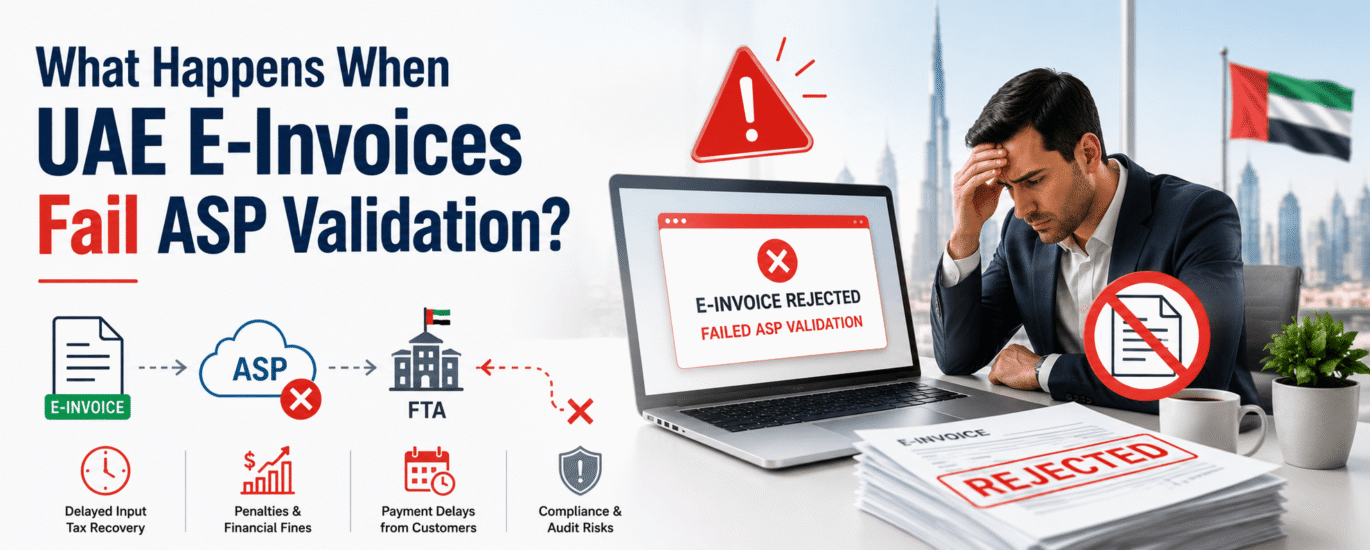
A failed ASP validation is not just a technical error you pass to IT. It means the invoice has no legal standing as a tax record until it is corrected and successfully retransmitted. Here is what that means for your business, what triggers it, and what your obligations are when it happens.
Most businesses preparing for UAE e-invoicing compliance focus on getting the setup right before go-live. That is the right instinct. But even well-prepared businesses encounter validation failures after the system is live, and the ones that handle them well are those that understood in advance what a failure actually means and what it requires them to do.
Under the UAE e-invoicing framework, an invoice that fails ASP validation has not entered the Peppol exchange network. It has not been delivered to the buyer in a compliant form. And until it is corrected and successfully transmitted, it does not exist as a valid tax record under UAE law. That is a different kind of problem from a bounced email or a formatting issue on a PDF. The invoice transmission failure has direct consequences for VAT reporting, input tax reclaims, and your FTA audit trail.
Understanding the difference between a rejected invoice and an e-invoicing system failure also matters here, because each triggers different obligations. A rejected invoice requires correction and resubmission. A system failure that prevents invoices from being issued or transmitted at all requires formal notification to the Federal Tax Authority within prescribed timelines, under Cabinet Decision No. 106 of 2025.
What counts as an e-invoicing system failure?
The UAE framework defines a system failure broadly. It is not limited to a complete server outage or a total loss of connectivity. Any disruption that prevents invoices from moving correctly through the compliance network can qualify, and the obligation to report it applies from the moment the failure is detected.
System failures that trigger FTA notification requirements include:
❌ Inability to generate PINT AE XML outputYour ERP loses the ability to produce structured invoice data in the required format. |
❌ API failure between ERP and ASPThe connection between your ERP and ASP breaks down, preventing invoice transmission. |
❌ ASP downtime or platform disruptionThe ASP experiences an outage or service interruption affecting invoice processing. |
❌ Invoices generated but not reaching the FTAInvoices appear successful but fail further down the reporting chain. |
A short disruption of a few hours still falls within reporting obligations once the mandate is live. Businesses that assume minor outages do not need to be reported are among the most common sources of avoidable penalties.
The most common ASP validation error categories
Separate from system-level failures, individual invoices can be rejected at the ASP validation stage for data quality or formatting reasons. These do not necessarily trigger FTA notification requirements, but they do mean the invoice is non-compliant until corrected. Understanding which error categories appear most often helps finance and operations teams know where to look first when a rejection comes back.
❌ Missing or incomplete mandatory fieldsThe most frequent cause of invoice rejection. Supplier TRN, buyer TRN, invoice number, issue date, and line-item data are all mandatory in the PINT AE invoice structure. A single absent or incorrectly formatted field fails the entire invoice. The root cause is usually weak master data rather than a one-off input error. |
❌ VAT mismatch between line-item and document totalsPINT AE requires VAT to reconcile at both line-item level and document level. If your ERP calculates VAT differently at each level, applies rounding inconsistently, or handles discounts in a way that does not carry through to the structured totals, the invoice will fail the reconciliation check. |
❌ Wrong tax scenario or transaction codeDifferent transaction types require different structured logic. Free Zone supplies, exports, margin scheme transactions, continuous supply arrangements, and summary invoices each carry specific scenario codes and data requirements. Applying standard invoice logic to a transaction that needs special handling produces a validation error even when the commercial details are correct. |
❌ Duplicate invoice submissionSubmitting an invoice reference that has already been used triggers an automatic rejection. This is more common than businesses expect, particularly after year-end invoice numbering resets or following ERP migrations where historical sequences are not fully reconciled. |
❌ Timing errorsInvoices not transmitted within the required window after issuance create a timing compliance failure. Credit notes and debit notes issued late against a compliant e-invoice carry the same risk. These are process discipline issues, not technical ones, but they produce the same validation outcome. |
What the AED 1,000 daily penalty actually means
Under Cabinet Decision No. 106 of 2025, businesses that fail to notify the FTA of an e-invoicing system failure within the required timelines face a penalty of AED 1,000 per day until the failure is formally reported. This is not a one-time fine for the failure itself. It accumulates for every day that passes between the failure occurring and the business notifying the FTA.
That distinction matters more than most businesses realise. The failure itself may be brief. The penalty is driven by how quickly the business reports it.
|
UAE E-Invoicing Penalty Framework — Cabinet Decision No. 106 of 2025 |
|
|
Failure to notify FTA of e-invoicing system failure within required timelines |
AED 1,000 / day |
|
Failure to appoint an Accredited Service Provider by the deadline |
Up to AED 5,000 / month |
|
Failure to issue invoices or credit notes within required timelines |
Up to AED 5,000 / month |
|
Failure to implement the e-invoicing system on time |
Separate penalty applies |
Businesses participating voluntarily before their mandated phase are generally not subject to these penalties. Once a business enters its mandatory phase, the full penalty framework applies. Always verify current penalty rates and timelines directly at tax.gov.ae as the framework may be updated.
The AED 1,000 daily penalty is triggered by delayed reporting of a system failure, not by the failure itself. A business that detects and reports a failure promptly is in a significantly better position than one that waits to confirm the issue or assumes a short outage does not need reporting.
Who is responsible when the ASP causes the failure?
This is one of the most important points for business owners and finance directors to understand before going live. When an Accredited Service Provider experiences an outage or service disruption that prevents invoice transmission, the instinct is often to assume the ASP will handle the reporting obligation. That assumption is incorrect.
Under the UAE e-invoicing framework, the compliance obligation remains with the business as the invoice issuer. Even when the fault lies entirely with the ASP’s infrastructure, the business may still be required to notify the FTA and maintain supporting records demonstrating the nature and timing of the failure. Relying on the ASP to handle this without active involvement from your side creates a compliance gap that is entirely avoidable.
Before going live, businesses should confirm with their ASP exactly what notification and reporting support they provide during outages, and what the business’s own obligations are in those scenarios. This is a governance question, not a technical one, and it should be settled during onboarding rather than during an actual failure.
How to handle a system failure when it happens?
System failure response process
1. Document immediatelyRecord the time the failure was detected, the nature of the issue, and which invoice transactions are affected. This log becomes your evidence record. |
|
↓
|
2. Contact your ASPNotify your Accredited Service Provider, confirm whether the fault is at their end or yours, and get a written response with their expected resolution timeline. |
|
↓
|
3. Report to the FTA without delayDo not wait to fully diagnose or resolve the issue before notifying the FTA. Report the failure first and update with details as they become available. Delayed reporting is where penalties accumulate. |
|
↓
|
4. Maintain all communication recordsKeep copies of FTA notifications, ASP correspondence, and internal incident logs. These are required if the FTA requests clarification during an audit. |
|
↓
|
5. Resume and reconcileOnce the failure is resolved, process any pending invoices, verify transmission status, and reconcile any gaps in the invoice reporting sequence with the FTA. |
What to do when an individual invoice is rejected
An invoice rejected at ASP validation is a different process from a system failure. No FTA notification is required for individual invoice rejections. But the rejected invoice does need to be corrected and resubmitted before it has any legal standing as a tax record.
The most important principle here is to fix the source data, not just the output. If an invoice fails because a buyer TRN is missing, updating the TRN on that one invoice and resubmitting it leaves the same gap open for every future invoice raised against that customer. The fix belongs in the customer master data record, not in the invoice document itself.
The same logic applies to VAT mismatch errors and calculation inconsistencies. Adjusting the final invoice figure to make it pass validation without fixing the underlying ERP calculation logic means the next invoice will fail for the same reason. These are the patterns that repeat most often in UAE e-invoicing implementations and cause the most rework over time.
How to reduce the risk of repeat failures
Most validation failures and system disruptions are preventable with the right controls in place before go-live. The businesses that experience the fewest post-live problems are generally those that treated the pre-live period as an opportunity to stress-test their setup rather than simply confirm it technically works.
Controls that reduce validation failure risk |
|
Getting your UAE e-invoicing integration right before the October 2026 deadline is the most effective way to reduce the risk of system failures and invoice rejections after the mandate goes live. The technical setup, data quality work, and end-to-end testing that happen during implementation are what determine how resilient your compliance process is once it is running for real.
Frequently asked questions
What happens if a UAE e-invoice fails ASP validation?
A rejected invoice has no legal standing as a tax record under UAE law until it is corrected and successfully retransmitted through an Accredited Service Provider. The buyer cannot use it to reclaim input VAT, and it does not appear in the FTA’s invoice exchange records. The invoice must be fixed at the source data level and resubmitted.
What is the penalty for e-invoicing system failure in the UAE?
Under Cabinet Decision No. 106 of 2025, businesses face a penalty of AED 1,000 per day for failing to notify the FTA of an e-invoicing system failure within the required timelines. Separate penalties of up to AED 5,000 per month apply for failing to appoint an ASP or failing to issue invoices within required timelines. Verify the current penalty framework at tax.gov.ae.
How do I report an e-invoicing system failure to the FTA?
Report through official FTA communication channels or portals without delay. Document the time and nature of the failure, identify affected transactions, notify your ASP, and keep records of all communications. Do not wait to fully resolve the issue before reporting. The penalty clock runs from when the failure occurred, not from when it was resolved.
Who is responsible when an ASP causes an e-invoicing failure?
The compliance obligation generally remains with the business as the invoice issuer, even when the failure originates with the ASP’s infrastructure. Businesses should not assume the ASP will handle FTA notification on their behalf. Confirm your respective obligations with your Accredited Service Provider during onboarding, before any failure occurs.
Can a rejected UAE e-invoice be resubmitted?
Yes. A rejected invoice can be corrected and resubmitted through your ASP once the underlying data issue is fixed. The key is to fix the root cause in the source data rather than adjusting the invoice output directly. Resubmitting without fixing the source means the same error will repeat on the next invoice raised against the same customer or using the same configuration.
What counts as an e-invoicing system failure in UAE?
Any disruption that prevents invoices from moving correctly through the compliance network. This includes inability to generate PINT AE XML output, API failures between ERP and ASP, ASP downtime, and invoices that are generated but never reach the FTA due to network or validation errors. Brief outages are not automatically exempt from reporting obligations.
How is a system failure different from an invoice validation error?
A system failure prevents invoices from being issued or transmitted at all and requires FTA notification. An individual invoice validation error means one specific invoice was rejected by the ASP due to a data or formatting issue. Validation errors require correction and resubmission but do not necessarily trigger FTA notification unless they reflect a broader system-level problem.
Concerned about how your ERP and ASP setup will hold up once e-invoicing goes live? Hitech can assess your current integration and help you build the controls that prevent validation failures before they become compliance problems.
Disclaimer:
The information in this article is based on the UAE e-invoicing framework, Cabinet Decision No. 106 of 2025, and publicly available FTA guidance as of June 2026. The UAE e-invoicing mandate has not yet gone fully live, and specific penalty enforcement mechanisms, validation rules, and FTA reporting procedures may be updated, revised, or clarified before and after the system becomes operational.
This article is intended for general informational purposes only and does not constitute legal, tax, or compliance advice. Businesses should verify all requirements, deadlines, and penalty frameworks directly with the Federal Tax Authority at tax.gov.ae or seek guidance from a qualified UAE tax professional before making compliance decisions.
Hitech Innovations takes no responsibility for actions taken or not taken based on the content of this article.