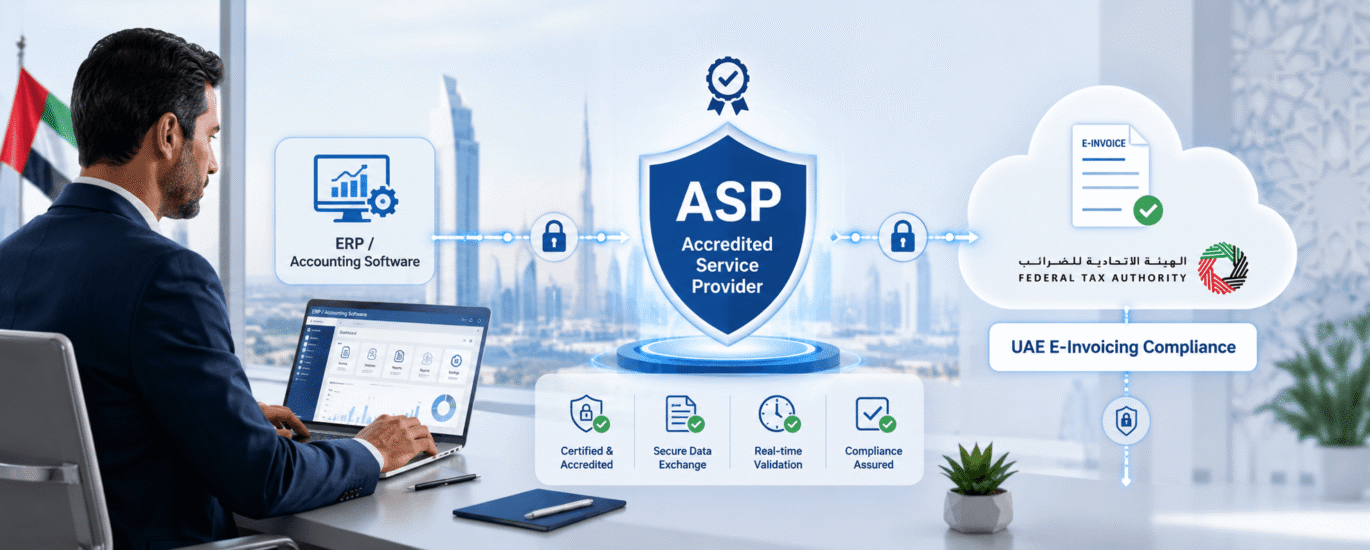
Every business required to comply with UAE e-invoicing will need to appoint an Accredited Service Provider before the October 2026 deadline. Here is what an ASP actually does — and why choosing the right one matters more than most businesses currently realise.
When businesses first look into UAE e-invoicing compliance, most of the early attention goes to their ERP or accounting software. That is a reasonable starting point. But there is a second, equally important piece that often gets less attention until it becomes urgent: the Accredited Service Provider.
The Federal Tax Authority’s e-invoicing framework does not allow businesses to transmit invoice data directly to the FTA or to their trading partners in whatever format their software currently produces. Instead, every compliant invoice must pass through a certified intermediary — an entity that has been formally accredited to validate, route, and deliver invoice data within the UAE’s invoice exchange network. That intermediary is the ASP.
Understanding what an ASP does, how it connects to your existing systems, and what to look for when appointing one is not a technical exercise. It is a business decision with compliance, operational, and cost implications — and the deadline to make it is 30 October 2026 for businesses with annual revenues of AED 50 million and above.
What does an Accredited Service Provider actually do?
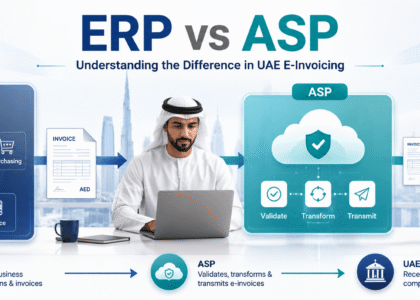
An ASP sits between your business and the UAE’s invoice exchange infrastructure. When your ERP or accounting system generates a structured e-invoice — in the PINT AE XML format required by the FTA — the ASP receives that invoice, validates it against the mandatory rules and data requirements, and routes it to the buyer through the Peppol network. It is the certified transmission layer that gives your invoice legal standing under the UAE e-invoicing mandate.
Think of it this way: your ERP creates the invoice. The ASP certifies and delivers it. Without the ASP step, the invoice does not meet FTA compliance requirements regardless of how well it was generated.
HOW AN INVOICE MOVES THROUGH THE UAE E-INVOICING NETWORK
1. Invoice generated: Your ERP or accounting software creates a structured XML invoice in PINT AE format, capturing all mandatory data fields.
↓
2. Transmitted to ASP: The invoice is sent to your Accredited Service Provider via API or secure data connection.
↓
3. Validated by ASP: The ASP checks the invoice against FTA validation rules: mandatory fields, TRN accuracy, VAT calculations, invoice structure.
↓
4. Routed via Peppol: The validated invoice is delivered to the buyer’s ASP through the Peppol access point network.
↓
5. Received and processed: The buyer’s system receives a compliant, validated invoice that meets FTA requirements and can be processed electronically.
Is an ASP the same as a Peppol access point?
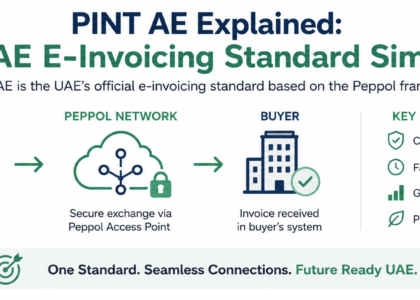
These two terms often appear together and are closely related but not interchangeable. A Peppol access point is the technical infrastructure that connects your business to the Peppol network — the international invoice exchange framework that UAE e-invoicing is built on. An Accredited Service Provider in the UAE context is an entity that has been formally certified by the relevant authority to operate within the UAE’s specific e-invoicing framework, including meeting local compliance, data, and security requirements.
In practice, most ASPs operating in the UAE will operate a Peppol access point as part of their service. But not every Peppol access point globally is automatically an accredited UAE ASP. When you are appointing a provider, the UAE accreditation status is what matters for compliance — not just Peppol connectivity.
Do all businesses need an ASP, or only large ones?
All businesses that fall within the UAE e-invoicing mandate will need to appoint an ASP — the phased rollout simply determines when. Businesses with annual revenues of AED 50 million and above must appoint their ASP by 30 October 2026, ahead of mandatory live invoicing on 1 January 2027. Smaller businesses have until 31 March 2027 to appoint an ASP, with mandatory compliance from 1 July 2027.
The size of your business does not change the requirement — it only changes when the requirement takes effect. And as covered in the UAE e-invoicing deadline guide, the onboarding and integration work required to actually be ready for live invoicing needs to start well before the appointment deadline arrives.
Can your ERP handle e-invoicing without an ASP?
This is one of the most common questions businesses ask — and the answer is no, at least not for compliant invoice exchange under the UAE mandate. Your ERP handles the generation side: capturing invoice data, formatting it to PINT AE XML, and passing it on. The ASP handles the transmission, validation, and delivery side.
Some ERP vendors are building direct ASP connectivity into their platforms, which simplifies the workflow from the user’s perspective. But even in those cases, an accredited provider is still involved behind the scenes. The distinction that matters practically is whether your ERP can generate a PINT AE-compliant XML invoice at all — and whether that output connects cleanly to whichever ASP you appoint.
Understanding the difference between what your ERP does and what an ASP does is the clearest way to assess what your business actually needs to put in place before the compliance deadline.
Important distinction: Appointing an ASP is a formal compliance step — not just a vendor selection. The October 2026 deadline refers specifically to the ASP appointment, not to having your system fully live. But the integration and testing work required to actually use the ASP for live invoicing means the practical lead time is longer than the deadline date implies.
What to look for when choosing an ASP?
Not all ASPs offer the same level of support, and the right choice depends on your existing technical environment and operational requirements. Here are the areas worth evaluating before you commit.
| ACCREDITATION
UAE-specific certification Confirm the provider holds formal UAE accreditation, not just general Peppol connectivity. |
INTEGRATION
ERP compatibility Check whether the ASP supports your specific ERP or accounting software — SAP, Oracle, Odoo, Zoho, Tally, or custom systems. |
| VALIDATION
Error handling and reporting Understand how the ASP surfaces validation failures and what support is available when invoices are rejected. |
ARCHIVING
Invoice storage and retrieval FTA requirements include invoice archiving. Check how the ASP handles long-term storage and retrieval for audit purposes. |
What happens to businesses that do not appoint an ASP by the deadline?
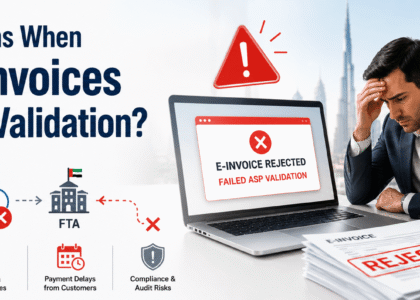
After the mandate goes live, invoices issued without passing through an Accredited Service Provider will not be legally valid tax records under UAE law. That has direct consequences for VAT compliance, invoice reclaim rights for your customers, and your ability to demonstrate accurate tax reporting to the FTA. The risk is not just a fine — it is invoices that have no legal standing. And if your system fails after go-live, the penalties and reporting obligations that follow an ASP validation failure add another layer of compliance exposure that most businesses do not anticipate.
Beyond the compliance risk, there is also a practical business impact. Large enterprises and government-linked entities are likely to enforce compliant invoice receipt requirements once the mandate is live. Businesses that have not completed their UAE e-invoicing integration by that point may find trading partners unable to accept their invoices.
How does ASP onboarding actually work?
Once you have selected an ASP, the onboarding process typically involves registering your business with the provider, configuring the technical connection between your ERP or accounting system and the ASP’s platform, and completing end-to-end testing to confirm that invoices generated by your system pass validation correctly. The timeline for this varies depending on the complexity of your ERP environment and the ASP’s onboarding process.
For businesses with customized ERP setups or multiple invoicing entities, this process takes longer. It is one of the main reasons that starting the implementation process well ahead of the October deadline is consistently the advice from compliance teams who have worked through similar mandates in other markets.
Frequently asked questions
What is an Accredited Service Provider in UAE e-invoicing?
An Accredited Service Provider is a certified intermediary that validates, transmits, and routes structured e-invoices between businesses and the FTA’s invoice exchange network. Every business within the UAE e-invoicing mandate must appoint one as a formal compliance requirement.
Do I need an ASP if my ERP already generates invoices?
Yes. Your ERP handles invoice generation — creating a structured PINT AE XML invoice. The ASP handles transmission and validation. Both are required for UAE e-invoicing compliance. Understanding the distinction between ERP and ASP roles helps clarify what each part of your setup needs to do.
How many ASPs are approved in the UAE?
The list of accredited providers is maintained by the relevant UAE authority and may expand as the mandate rolls out. Check the FTA’s official portal at tax.gov.ae for the current approved list.
Can one ASP work with any ERP system?
Most ASPs support integration with major ERP platforms, but compatibility with your specific system, version, and configuration needs to be confirmed before you appoint a provider. This is particularly relevant for businesses running older ERP versions or heavily customized accounting environments.
What is the deadline to appoint an ASP in the UAE?
Businesses with annual revenues of AED 50 million and above must appoint an ASP by 30 October 2026. Smaller businesses have until 31 March 2027. These are appointment deadlines — the mandatory live invoicing dates follow shortly after. See the full UAE e-invoicing implementation timeline for all key dates.
Does the ASP store my invoice data?
Most ASPs provide invoice archiving as part of their service, which is relevant for FTA audit and reporting requirements. Confirm the data retention policy, storage location, and retrieval process with any provider you are evaluating — especially if your business has data residency requirements.
Not sure how your ERP connects to an ASP, or which integration approach suits your current setup? Hitech can assess your environment and help you plan the right path before the October deadline.