If you have come across the term PINT AE and are not sure what it means for your business, this article breaks it down plainly. No XML expertise required.
When the Federal Tax Authority published the technical framework for UAE e-invoicing, it specified a single structured format that all compliant invoices must follow: PINT AE. Every business that falls within the UAE e-invoicing mandate will be generating invoices in this format, whether they interact with it directly or not.
For most business owners and finance directors, the format itself is not something you will configure personally. But understanding what it is, what it requires, and why it exists helps you ask the right questions when evaluating your ERP readiness or speaking with an Accredited Service Provider. That understanding also determines how prepared your business actually is before the October 2026 compliance deadline.
What is PINT AE?
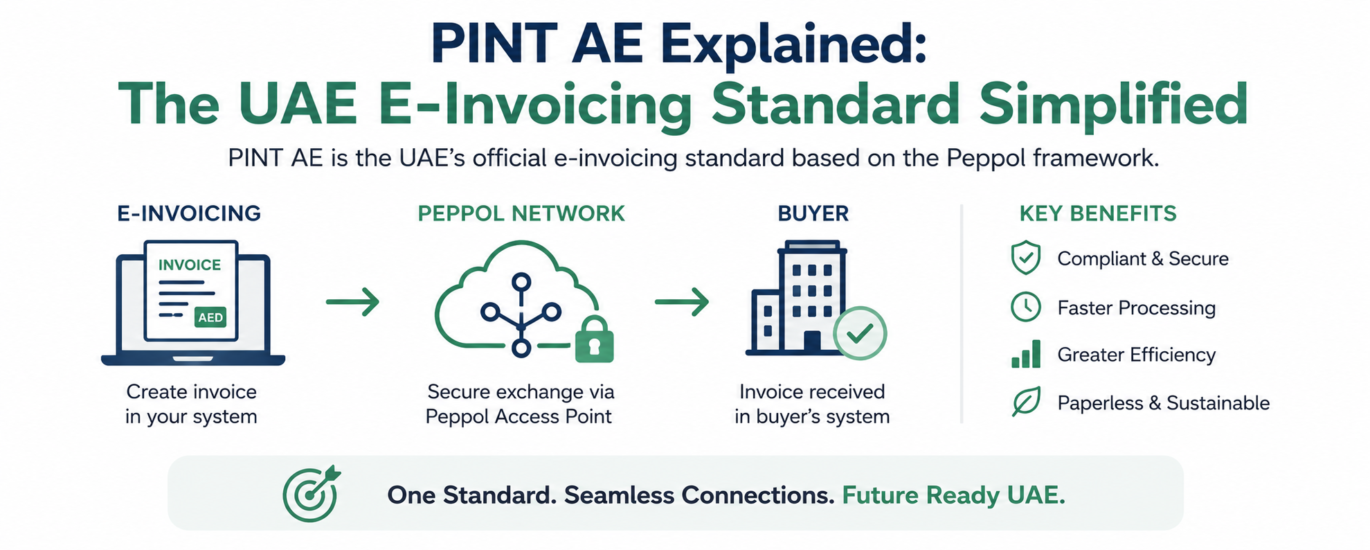
PINT AE stands for Peppol International Invoice UAE. It is the standardized data model and XML schema that defines how e-invoices must be structured in the UAE. The “Peppol” part refers to the international e-invoicing network and framework that the UAE has adopted as the foundation for its system. The “AE” part refers to the UAE-specific extensions and requirements layered on top of the international standard.
In practical terms, PINT AE is the specification that tells your ERP or accounting software exactly what data fields an invoice must contain, what format each field must be in, and how the overall document must be structured so it can be validated and exchanged electronically. A PINT AE invoice is not a PDF or an email attachment. It is a structured XML file that systems can read, validate, and process automatically.
PINT AE is based on the global Peppol BIS Billing 3.0 standard, with additional fields and rules specific to UAE tax law, VAT requirements, and the FTA’s invoice exchange network. The “AE” suffix signals these local extensions.
Why does the UAE use this standard and not something else?
The decision to build UAE e-invoicing on the Peppol framework was deliberate. Peppol is already in use across dozens of countries for cross-border and domestic e-invoicing, which means the underlying technical infrastructure, the access point network, and the validation rules are proven and widely supported by ERP vendors and software providers globally.
By adopting PINT AE rather than creating a completely proprietary format, the UAE makes it easier for multinational businesses with existing Peppol-connected systems to adapt to compliance requirements without starting from scratch. It also gives UAE-based businesses access to a wider range of ASPs and software integrations than a fully custom format would allow.
How is PINT AE different from a PDF invoice?
This is worth spending a moment on because the gap is larger than most businesses expect.
|
PDF Invoice Human-readable only A PDF is a visual document. A person can read it, but a system cannot reliably extract structured data from it. There is no standardized way for a computer to know which number is the VAT amount versus the line total versus a discount. |
PINT AE XML Invoice Machine-readable and structured A PINT AE invoice is a structured data file. Every field has a defined location, label, and format. Systems can validate it instantly, route it automatically, and process it without human intervention. |
Under the UAE e-invoicing mandate, PDF invoices will not have legal standing as tax records once the compliance dates take effect. The invoice that matters — legally and operationally — is the structured XML invoice that has passed through an Accredited Service Provider for validation and transmission.
What data fields does PINT AE require?
PINT AE defines both mandatory fields — which every invoice must include — and conditional fields that apply in specific circumstances (for example, credit notes, or invoices with multiple tax categories). The mandatory fields cover the core information the FTA needs for tax reporting and compliance validation.
Core mandatory fields in a PINT AE invoice
| • Invoice number (unique)
• Invoice issue date • Invoice type code • Supplier name and TRN • Buyer name and TRN |
• Supplier address
• Buyer address • Currency code • Line item descriptions • Line item quantities and unit prices |
• VAT category and rate per line
• VAT amount per line • Invoice totals (net, VAT, gross) • Payment terms |
If any of these fields are missing, incorrectly formatted, or contain data that does not match FTA records (for example, a TRN that does not correspond to a registered business), the invoice will fail validation at the ASP level and will not be transmitted. This is why data quality across your customer and supplier records matters as much as the technical format itself. It also determines how validation errors are handled once an invoice is rejected and what your team needs to do to correct and resubmit it.
Understanding the most common validation errors and compliance mistakes before you go live can prevent a significant amount of rework during implementation.
Does your ERP need to generate PINT AE output directly?
Yes — or it needs to be configured to do so. The starting point for any compliant e-invoice is a system that can produce a valid PINT AE XML file. Some ERP platforms are adding native PINT AE output to their modules. Others require middleware or integration connectors to convert their internal invoice data into the correct format before passing it to an ASP.
The specific path for your business depends on which ERP or accounting software you are using, what version it is on, and how your invoice data is currently structured. An ERP readiness assessment is the most direct way to understand what your system needs to produce compliant PINT AE output and how much configuration or development work is involved.
Is PINT AE mandatory for all invoice types?
PINT AE applies to all B2B tax invoices issued by businesses within the UAE e-invoicing mandate. This includes standard invoices, credit notes, and debit notes. The specific mandatory fields may vary slightly depending on the invoice type, but the underlying XML schema and the requirement to transmit through an ASP applies across all of them.
B2C invoices are not in scope under the current UAE e-invoicing mandate. The requirement applies to B2B transactions only, at least in the initial phases of the rollout.
One thing worth checking early: if your business issues invoices across multiple legal entities or across different billing systems, each of those needs to produce PINT AE-compliant output. It is not uncommon for businesses to discover during an ERP assessment that their main system is ready but secondary billing tools are not.
What role does PINT AE play in the broader UAE e-invoicing setup?
PINT AE is the format layer — it defines what the invoice contains and how it is structured. The transmission layer is handled by the Peppol network and your Accredited Service Provider, which validates the PINT AE invoice and routes it to the buyer. The compliance layer is enforced by the FTA, which receives reporting data from the ASPs operating within the network.
These three layers work together. A well-formed PINT AE invoice that is transmitted through an accredited ASP and accepted by the buyer’s system is what a fully compliant UAE e-invoice looks like in practice. Understanding how your ERP and ASP work together in this setup clarifies where your current gaps are and what needs to change before the mandate goes live.
Frequently asked questions
What is PINT AE?
PINT AE is the Peppol International Invoice UAE standard. It is the structured XML data model that defines how all compliant e-invoices must be formatted under the UAE e-invoicing mandate. It is based on the international Peppol BIS Billing 3.0 framework with UAE-specific extensions for local tax and compliance requirements.
Is PINT AE mandatory for all UAE businesses?
Yes, for all businesses within the e-invoicing mandate. The phased rollout determines when each group must comply, but PINT AE is the required format for all B2B tax invoices once the mandate applies. See the UAE e-invoicing deadline and timeline for the relevant dates for your business.
What is the UAE invoice format?
The UAE invoice format for e-invoicing purposes is PINT AE — a structured XML file that contains all mandatory invoice data in a standardized, machine-readable format. PDF invoices and other unstructured formats will not meet FTA compliance requirements once the mandate is live.
How is PINT AE different from a standard PDF invoice?
A PDF invoice is a visual document readable by people but not reliably by systems. PINT AE is a structured data file where every field has a defined location and format. Systems can validate, route, and process it automatically. Under the UAE mandate, only PINT AE-formatted invoices transmitted through an ASP will have legal standing as tax records.
What data fields are required in a PINT AE invoice?
Mandatory fields include supplier and buyer name and TRN, invoice number, issue date, invoice type, line item descriptions and quantities, VAT category and rate per line, VAT amount per line, and invoice totals. Missing or incorrectly formatted fields will cause the invoice to fail ASP validation.
Does my ERP automatically support PINT AE?
It depends on your ERP and its current version. Some platforms are adding native PINT AE support; others require configuration or middleware. An ERP readiness assessment is the most reliable way to understand what your specific system needs to produce compliant output.
Not sure whether your ERP can produce PINT AE-compliant invoices? Hitech can assess your current setup and map the steps needed before the October 2026 deadline.