
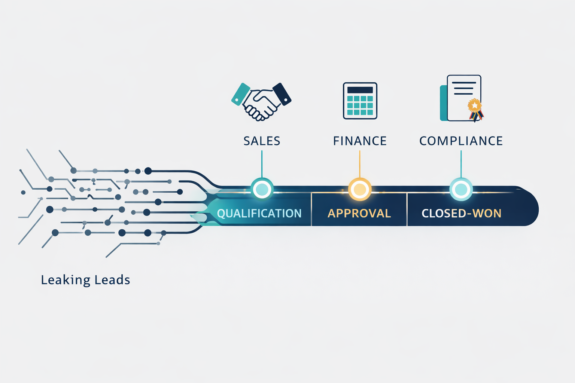
High-value deals rarely disappear overnight. In most UAE B2B environments, they gradually lose momentum due to delayed coordination, unclear ownership, and fragmented communication. These opportunities typically begin with strong intent, multiple stakeholder discussions, and clear business alignment — yet they stall before reaching decision stage.
Unlike transactional leads, high-value prospects UAE require structured handling. They involve customised pricing, multi-level approvals, compliance-sensitive documentation, and longer evaluation cycles. When these activities are managed manually, delays emerge, follow-ups weaken, and engagement slowly declines.
Many organisations misinterpret this as a lead generation problem. In reality, it is an execution issue. Opportunities remain in the B2B sales pipeline UAE, but lack of visibility and coordination creates silent drop-offs. By the time sales teams recognise the risk, the buyer has already shifted focus.
This results in missed opportunities UAE, not because of pricing or product mismatch, but due to operational friction. Understanding exactly where this leakage occurs is the first step toward improving enterprise deal conversion.
Identifying the “Leakage” Points in Your UAE B2B Sales Pipeline
High-value opportunities do not fail at one stage. Instead, lead leakage UAE occurs gradually across qualification, proposal, approvals, and negotiation. As deal size increases, the number of stakeholders and internal dependencies grows, making structured execution critical.
Without defined processes, high-value prospects UAE move through disconnected conversations, manual tracking, and delayed internal coordination. These execution gaps weaken deal momentum and increase drop-off risk.
Manual Lead Handling and Fragmented Communication Channels
Many organisations still rely on manual lead management UAE using spreadsheets, emails, and messaging platforms. While manageable for small deals, this approach creates visibility gaps for enterprise opportunities.
Common issues include:
- Conversations spread across multiple platforms
- No centralised engagement history
- Proposal versions lost in email threads
- Missed follow-ups due to manual reminders
- Stakeholder inputs scattered across teams
In many cases, WhatsApp email lead tracking UAE becomes the default workflow. Critical information gets buried in chats, making it difficult to track progress or align teams.
Fragmented communication slows response time and reduces buyer confidence. When engagement appears inconsistent, prospects assume internal inefficiencies and begin evaluating alternatives. Accessing expert insights on modernising these workflows is essential for maintaining professional momentum and securing high-value commitments.
No Ownership or Accountability for Enterprise-Size Deals
Enterprise opportunities often expose sales ownership gaps UAE, especially when multiple stakeholders participate internally. Without a defined owner, accountability becomes unclear.
Typical issues include:
- Multiple team members contacting the same prospect
- No single point of accountability
- Delayed responses waiting for inputs
- Inconsistent communication with decision-makers
- Unclear next steps in the pipeline
These challenges affect enterprise deal management UAE, where coordination between sales, finance, and delivery becomes essential. Without ownership, opportunities stall between departments.
From the buyer’s perspective, this appears as organisational uncertainty. From the organisation’s perspective, the deal seems active but lacks forward movement.
Slow Follow-Ups That Kill High-Intent Buyers
High-value prospects typically evaluate multiple vendors simultaneously. This makes B2B response time UAE a critical factor in conversion. Even short delays reduce engagement momentum.
Common follow-up issues include:
- Delayed quotation preparation
- Waiting for pricing approvals
- No structured follow-up cadence
- Manual reminders missed
- Proposal revisions taking too long
These delays create delayed follow up UAE scenarios where the buyer loses urgency. When responses are slow, prospects interpret it as execution risk.
Momentum loss is one of the most common contributors to enterprise opportunity leakage.
Disconnected Sales, Finance, and Operations Teams
Large deals require collaboration across departments. However, many organisations experience sales finance misalignment UAE, especially during pricing and delivery commitments.
Typical breakdowns include:
- Finance reviewing pricing too late
- Operations unaware of commitments
- Sales promising timelines without validation
- Proposal revisions delayed internally
- No shared deal visibility
This creates cross department lead leakage UAE, where opportunities weaken during final evaluation. Buyers expect coordinated engagement, and internal disconnects reduce confidence.
These operational gaps not only affect conversion but also introduce deeper business risks.
The Hidden Business and Compliance Risks of Losing High-Value Prospects
Losing enterprise opportunities affects more than immediate revenue. Over time, UAE revenue leakage impacts forecasting accuracy, operational planning, and growth predictability. High-value deals typically represent a significant portion of projected pipeline value.
When these opportunities disappear without visibility, organisations face increasing pipeline risk UAE, making it difficult to plan hiring, procurement, and expansion.
In regulated UAE environments, the issue extends further. Inconsistent approvals, undocumented pricing, and fragmented communication introduce compliance risk sales UAE, especially during audits or financial reviews.
Revenue Forecasting Becomes Unreliable and Reactive
When enterprise opportunities leak, sales forecasting UAE SMEs becomes assumption-based. Large deals heavily influence quarterly projections, so even one drop-off distorts expectations.
Without proper pipeline visibility UAE, businesses experience:
- Overestimated revenue projections
- Last-minute sales pressure
- Reactive discounting
- Poor hiring decisions
- Unpredictable cash flow
Leadership begins planning around uncertain pipelines, making growth reactive instead of strategic.
Pricing, Quotation, and Approval Delays Reduce Win Rate
Enterprise buyers expect fast turnaround on proposals. However, quotation delays UAE often occur when pricing approvals are manual.
Common challenges include:
- Multiple quotation revisions
- Informal discount approvals
- Slow management sign-offs
- No version control
- Delayed proposal submission
Lack of structured approval workflow sales UAE slows decision-making. While prospects are ready to move forward, internal bottlenecks weaken engagement.
Competitors with faster response times often secure the deal.
Multi-Entity UAE Operations Increase Prospect Drop-Off
Many UAE companies operate across entities or branches. In such environments, multi entity UAE sales require coordination across teams and pricing structures.
Without centralised control, group company pipeline UAE issues emerge:
- Conflicting quotations from entities
- Multiple contact points
- Unclear billing structures
- Delayed coordination
- Ownership confusion
This complexity increases drop-off risk during final decision stages.
Audit, VAT, and Documentation Gaps in Pre-Sales Activities
Enterprise opportunities involve pricing negotiations and custom terms. When not documented properly, VAT documentation UAE sales gaps appear.
Common risks include:
- Discounts without audit trail
- Pricing changes not tracked
- Proposal revisions undocumented
- Contract mismatches
- Missing negotiation history
Lack of audit trail CRM UAE visibility affects audit readiness and financial transparency. Pre-sales activities become part of compliance exposure.
To prevent these risks, organisations need a structured opportunity management framework.
A Structured Framework to Capture and Convert High-Value Prospects
Preventing leakage requires a defined high value lead framework UAE that standardises how enterprise opportunities are qualified, tracked, and progressed. A structured enterprise sales process UAE introduces accountability and visibility.
This framework enables pipeline governance UAE, ensuring high-value deals move through defined checkpoints rather than informal tracking.
Define Qualification Criteria for High-Value Opportunities
Organisations must define lead qualification UAE rules to identify strategic opportunities early.
Typical criteria include:
- Deal value threshold
- Stakeholder complexity
- Custom pricing requirements
- Implementation scope
- Multi-entity involvement
- Decision timeline
Applying high value opportunity scoring ensures:
- Priority follow-ups
- Senior involvement
- Faster proposals
- Early risk identification
- Structured engagement
Qualification prevents enterprise deals from being treated as regular leads.
Establish Pipeline Stages with Decision Checkpoints
Enterprise deals require defined sales pipeline stages UAE with progression criteria.
Typical stages include:
- Qualified opportunity
- Requirement validation
- Solution alignment
- Commercial proposal
- Negotiation
- Decision
This introduces deal governance UAE, allowing leadership to identify stalled opportunities and bottlenecks.
Decision checkpoints ensure continuous movement.
Implement SLA-Based Follow-Ups and Escalations
High-value opportunities require disciplined engagement. Follow up SLA UAE defines response timelines.
This includes:
- Response time targets
- Proposal turnaround deadlines
- Follow-up frequency
- Escalation triggers
- Internal coordination SLAs
A structured sales escalation workflow UAE ensures inactive deals receive attention before momentum drops.
Create Unified Visibility Across Sales, Finance, and Delivery
Enterprise deals require collaboration. Unified pipeline visibility UAE ensures all teams share information.
This improves:
- Pricing validation
- Delivery confirmation
- Approval tracking
- Forecast accuracy
- Deal monitoring
Strong sales operations alignment UAE reduces delays and improves conversion consistency.
Turning Strategy into Execution with Integrated Business Systems
Frameworks alone cannot prevent leakage. UAE businesses must operationalise processes using ERP CRM integration UAE that connects sales, finance, and operations.
This enables sales automation UAE and pipeline automation UAE, reducing reliance on manual coordination.
Centralised Prospect Intelligence Across Departments
High-value deals involve multiple stakeholders. A centralised CRM UAE ensures all interactions are tracked.
This creates unified customer data UAE accessible across teams, improving collaboration and decision speed.
Automated Quotations, Approvals, and Deal Tracking
Manual proposal handling slows enterprise deals. Automated quotation UAE workflows reduce turnaround time.
With approval workflow automation UAE, organisations can:
- Route pricing approvals
- Apply discount controls
- Track revisions
- Maintain audit trails
- Monitor pipeline stages
Modern platforms like Odoo help unify CRM, quotations, approvals, and pipeline visibility, allowing high-value prospects to move through structured stages without manual coordination.
Real-Time Forecasting and Revenue Predictability
System-driven pipelines enable sales forecasting automation UAE. Leadership gains visibility into opportunity movement.
Using pipeline analytics UAE, businesses can monitor conversion rates, closing timelines, and revenue projections.
Scalable Framework for Multi-Branch UAE Businesses
Growing organisations require centralised tracking. Multi branch CRM UAE ensures consistent handling across locations.
Integrated within scalable ERP UAE sales environments, this enables unified opportunity management across entities.
Common Questions on High-Value Prospect Management in UAE B2B Sales
Why do high-value prospects slip through pipelines in UAE companies?
High-value prospects are often lost due to fragmented communication, delayed approvals, and unclear ownership. Enterprise opportunities typically require coordination between sales, finance, and operations, which slows progress when processes are manual. Without centralised visibility and structured follow-ups, engagement weakens and decision-makers shift to faster-moving competitors.
How can UAE SMEs identify high-value opportunities early?
UAE SMEs should define deal value thresholds, stakeholder complexity, and implementation scope to identify strategic opportunities. Early qualification allows teams to prioritise engagement, assign ownership, and involve senior stakeholders. This structured handling ensures high-value prospects receive faster responses and consistent follow-ups.
What is the biggest operational mistake in managing enterprise prospects?
The most common mistake is treating high-value opportunities like regular leads. Enterprise deals require defined pipeline stages, coordinated approvals, and cross-department collaboration. Without structured governance, opportunities stall between teams, resulting in delayed proposals and reduced conversion probability.
How does poor follow-up impact B2B conversion rates in UAE?
Delayed follow-ups reduce urgency and signal operational inefficiency to prospects. High-value buyers often evaluate multiple vendors simultaneously, making response time critical. When quotations or clarifications are slow, decision-makers lose confidence and prioritise vendors with faster turnaround.
Should sales and finance teams share pipeline visibility?
Yes, shared visibility improves pricing accuracy, speeds approval cycles, and reduces last-minute revisions. Finance can validate margins early while sales maintains deal momentum. This alignment improves forecasting accuracy and prevents delays during final negotiation stages.
How do multi-entity UAE companies manage large prospects?
Multi-entity businesses should centralise opportunity tracking across branches and legal entities. This prevents conflicting quotations, unclear ownership, and coordination delays. Unified visibility ensures consistent communication and smoother progression for enterprise prospects.
What systems help prevent high-value lead leakage?
Integrated CRM and ERP systems with pipeline tracking, approval workflows, and automated follow-ups reduce dependency on manual coordination. These systems provide centralised visibility, enforce structured stages, and improve response time. As a result, high-value prospects are managed consistently throughout the sales cycle.
