
Picking the wrong ERP system does not just slow your business down. It locks you into years of expensive workarounds, frustrated staff, and missed growth opportunities. UAE businesses navigating VAT compliance, rapid expansion, and the pressures of digital transformation all at once know that decision carries real weight.
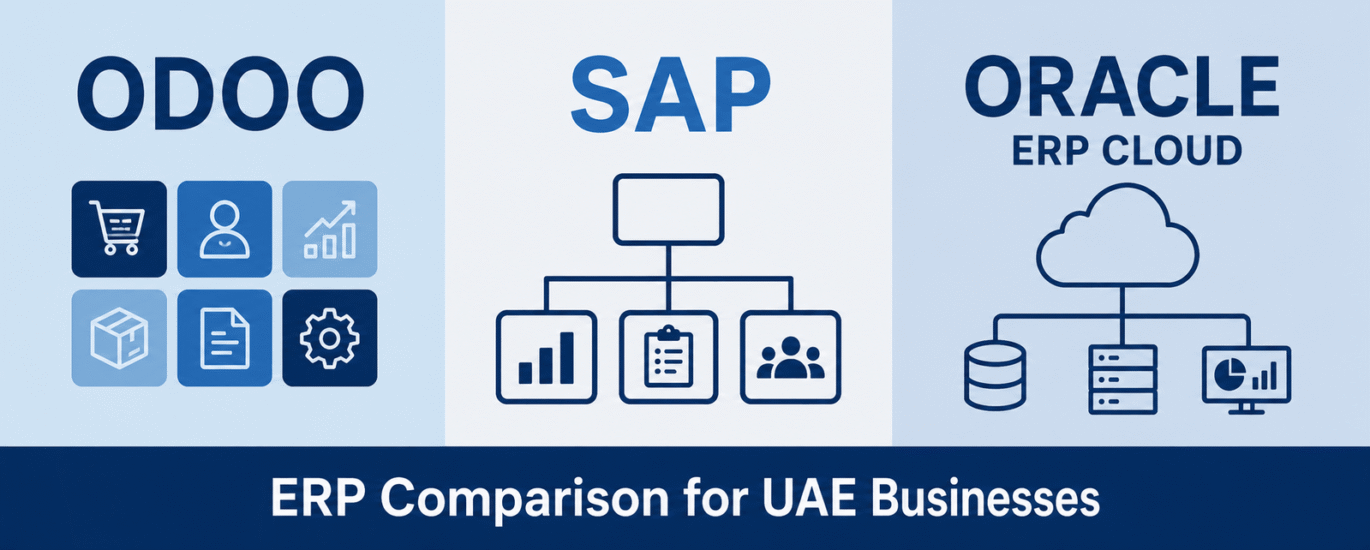
Odoo, SAP, and Oracle are the three platforms that consistently come up in this ERP software comparison across the UAE market. Each is credible. Each has genuine strengths. But they were built for very different types of businesses, and recommending one over the other without understanding your size, budget, and operational complexity would be doing you a disservice.
This guide breaks down the honest differences between all three, covers the compliance and cost factors that matter most, and helps you figure out which platform actually fits where your business is today, and where it is heading. Whether you are evaluating ERP for the first time or outgrowing your current setup, this is the comparison UAE businesses actually need.
Understanding the Core Difference Between Odoo, SAP, and Oracle
Before comparing features, it helps to understand the fundamental difference in how these three platforms were designed. They were not built for the same customer, and that matters more than any feature list.
Odoo was built modularly from the ground up. You start with what you need: accounting, CRM, inventory, HR, and expand the system as your operations grow. That flexibility makes it a consistently preferred choice among SMEs, trading companies, retail businesses, and fast-growing startups looking for capable SME ERP software in the UAE without the overhead of an enterprise deployment.
SAP was designed for large enterprises managing high-volume, structured operations: manufacturing groups, global distributors, conglomerates. Its strength is deep process standardisation and centralised control. SAP deployments are resource-intensive, and customising them for businesses with rapidly evolving needs can become expensive quickly.
Oracle ERP occupies the cloud-first enterprise space. Built for organisations operating across multiple entities, regions, or international markets, it prioritises centralised financial governance and advanced analytics. Like SAP, the investment required, in both cost and internal technical capability, reflects that enterprise positioning.
For UAE SMEs, the real choice often comes down to Odoo versus the other two. Not because SAP and Oracle lack quality. Because their cost structure and implementation complexity regularly exceed what growing businesses actually need.
Odoo vs SAP vs Oracle: Quick Comparison for UAE Businesses
The table below gives you the fast answer across the criteria that matter most to UAE businesses. The sections that follow explain the reasoning behind each assessment in detail.
| Criteria | Odoo | SAP | Oracle ERP |
| Best suited for | SMEs, startups, trading and retail businesses | Large enterprises, manufacturing, conglomerates | Multi-country enterprise organisations |
| Typical implementation timeline | 6 to 14 weeks | 6 to 18 months | 9 to 24 months |
| Approximate cost range | Low to moderate | High | High to very high |
| UAE VAT compliance | Strong, flexible localisation | Yes, enterprise-grade | Yes, enterprise-grade |
| UAE e-invoicing readiness | Configurable via local partners | Supported | Supported |
| Customisation flexibility | High, open-source architecture | Moderate, requires certified consultants | Moderate, requires specialist consultants |
| Cloud infrastructure | Cloud and on-premise options | SAP S/4HANA Cloud and on-premise | Cloud-first architecture |
| HR and payroll management | Native module included | Available, complex setup | Available, enterprise-focused |
| Inventory and supply chain | Native, strong for SME operations | Deep enterprise capability | Deep enterprise capability |
| Multi-company management | Supported in enterprise edition | Supported | Supported |
| Arabic language support | Yes | Partial, partner-dependent | Partial, partner-dependent |
| Suitable for UAE SMEs | Yes, strongly recommended | Limited, cost prohibitive for most SMEs | No, designed for large organisations |
Comparing ERP Systems Across Key UAE Business Requirements
Choosing the right ERP system becomes easier when businesses evaluate platforms based on practical operational requirements instead of brand popularity alone. UAE companies today must consider factors such as VAT compliance, implementation costs, scalability, integration flexibility, and long-term operational efficiency before investing in an ERP solution.
While Odoo, SAP, and Oracle all provide core ERP functionality, the overall business impact often depends on how effectively each platform supports local compliance requirements and future business expansion.
UAE VAT, E-Invoicing, and Compliance Readiness
VAT compliance is not optional. Since the Federal Tax Authority introduced VAT in 2018, and as the UAE moves toward mandatory e-invoicing under its digital tax infrastructure, your ERP must handle these requirements reliably, not through manual workarounds that create audit risk.
Odoo provides strong localisation for UAE VAT workflows. Tax configuration, invoice formatting, and VAT return reporting are all managed within the platform. The open-source architecture means local ERP implementation partners in the UAE can customise compliance processes as FTA regulations evolve. This is a practical advantage for businesses without a dedicated compliance or IT team.
SAP and Oracle both support UAE VAT, but their compliance frameworks were built for large-scale financial operations. A business processing a few hundred invoices monthly will find the overhead of managing VAT inside SAP or Oracle often requires specialist configuration and recurring consultant involvement.
If you need clean, auditable VAT compliance without maintaining a large IT function, Odoo’s flexibility is a real differentiator here.
Implementation Cost and Deployment Time
This is where the ERP software comparison becomes most significant for UAE SME owners.
Odoo’s modular licensing means you pay for what you use. A business can go live on accounting, sales, and inventory for a fraction of what a comparable SAP or Oracle deployment would cost, and typical SME deployments complete in weeks to three months, not the 6 to 18 month enterprise projects that SAP and Oracle routinely involve.
SAP Business One narrows the gap somewhat. It still carries higher per-user licensing costs and a more rigid process than Odoo. Oracle’s cloud ERP pricing is structured around enterprise contracts that are genuinely difficult to scale down for smaller operations. Both platforms were designed with procurement teams and IT departments in mind, not SME owners watching cash flow.
A UAE trading business that needed to go live quickly and within budget chose Odoo over SAP Business One largely for this reason. With a certified ERP implementation partner in the UAE, their entire operation, covering purchasing, sales, inventory, and accounting, was live within ten weeks. That timeline would have been impossible at a comparable cost with the enterprise alternatives.
Customisation Flexibility
UAE businesses often have operational processes that do not fit neatly into out-of-the-box ERP workflows. Multi-branch approval structures. Arabic-English bilingual reporting. Industry-specific requirements in construction, trading, hospitality, or professional services. These are not edge cases. They are standard operating reality for many UAE SMEs.
Odoo’s open-source architecture means these customisations are genuinely achievable. A qualified Odoo ERP implementation partner in the UAE can tailor workflows, approval chains, and reports to match how your business actually operates.
SAP and Oracle support customisation too. But doing so typically requires certified consultants, longer project timelines, and costs that can quickly exceed what the original platform investment justified. Businesses that need ERP to fit their operations, rather than the other way around, tend to find Odoo’s approach more practical.
Scalability and Multi-Company Management
Can Odoo grow with your business? It is the question SME owners ask most often. The honest answer is yes, and it handles more than most people expect.
Odoo’s enterprise edition manages multi-company operations, multi-currency transactions, and multi-branch reporting natively. Businesses that implement Odoo at 20 employees regularly scale through it to 200-plus without switching platforms. Adding HR and payroll management, a manufacturing module, e-commerce, or a full inventory and supply chain management suite is a configuration step, not a re-implementation project.
What SAP and Oracle handle better is genuinely complex multi-entity group structures: enterprise-grade financial consolidation across dozens of legal entities, global regulatory compliance across multiple jurisdictions, advanced analytics at group level. UAE-based conglomerates and regional holding groups with those requirements will find value in the enterprise platforms. Most SMEs will not reach that threshold for years, if ever.
Inventory, Supply Chain, and Operational Automation
Trading companies and distributors make up a significant slice of the UAE SME market. These businesses need ERP that genuinely handles inventory management, purchase orders, supplier management, and logistics without bolting on third-party tools to fill gaps.
Odoo’s inventory and supply chain capabilities are among its strongest. Automated reorder rules, barcode scanning, multi-warehouse management, and real-time stock visibility are all included natively.
More importantly, Odoo is built so every part of the system talks to each other. Through its native integration and modules covering inventory, accounting, and sales, the full order-to-cash and procure-to-pay cycle runs automatically. No manual data entry between systems. No reconciliation headaches at month end. For trading companies in the UAE, that connected ecosystem is where the real operational efficiency comes from.
SAP and Oracle offer deep supply chain functionality as well. At enterprise scale, for businesses managing regional distribution networks or global procurement operations, that depth matters. For a UAE trading SME managing stock across two or three warehouses, it is far more than what the situation requires.
Which ERP Solution Is the Best Choice for Your Business Size?
There is no single ERP platform that fits every business perfectly. The right ERP depends on company size, operational complexity, budget flexibility, and long-term growth plans. While some UAE businesses prioritize affordability and customization, others require enterprise-level governance, advanced analytics, or large-scale process management.
Understanding where Odoo, SAP, and Oracle fit best helps businesses make a more practical and future-ready ERP decision.
Odoo: The Strongest Choice for UAE SMEs
Odoo is the right fit if your business matches any of these profiles:
- SMEs with 10 to 250 employees looking for best ERP software in the UAE without enterprise-level pricing
- Trading, distribution, and retail businesses that need inventory, sales, and accounting tightly connected
- Fast-growing startups that want to deploy core modules now and activate more as they scale
- Businesses with UAE-specific requirements, including VAT localisation, Arabic reporting, and industry workflows
- Companies that have outgrown accounting tools like QuickBooks or Zoho Books but are not ready for a full enterprise ERP deployment
If you need ERP operational within 2 to 4 months, within a defined budget, and simple enough that your team uses it properly from day one, Odoo is the realistic choice. It is also why ERP consulting teams across the UAE recommend it most consistently for this segment.
SAP: When Enterprise Scale Justifies the Investment
SAP makes strategic sense when your business genuinely operates at enterprise scale: structured manufacturing, complex multi-entity procurement, strict governance reporting across regional operations. If your transaction volumes and process complexity require the standardisation SAP provides, the investment is justified.
Most UAE SMEs reading this are not there yet.
Oracle: Cloud Infrastructure for Large Organisations
Oracle suits large organisations managing multi-country operations, enterprise-level financial consolidation, and advanced analytics across business units. If your organisation is a regional group operating across the GCC and needs centralised cloud ERP infrastructure and governance at scale, Oracle deserves a serious look.
Its value proposition and cost structure are built for organisations above a certain size threshold. Smaller businesses that evaluate Oracle typically conclude the same thing: capable platform, wrong context.
What UAE Business Owners Ask Before Choosing an ERP
Which ERP is best for UAE businesses?
It depends on size and operational complexity. For SMEs, Odoo consistently delivers the strongest combination of cost-efficiency, UAE compliance support, and customisation flexibility, making it the most practical choice for the majority of UAE businesses. SAP suits large enterprises requiring structured governance, while Oracle is best positioned for multi-country, cloud-first enterprise environments.
Is Odoo better than SAP for SMEs?
For most UAE SMEs, yes. Odoo is more affordable to license, faster to implement, easier to customise for local requirements, and simpler for non-technical staff to use day to day. SAP’s strength is deep process standardisation, which delivers real value at enterprise scale. For a growing SME, that same standardisation often creates unnecessary rigidity and cost.
Which ERP supports UAE VAT and e-invoicing?
All three platforms support UAE VAT. Odoo provides the most adaptable localisation for SMEs. VAT workflows, FTA-aligned invoice formats, and e-invoicing readiness are all configurable through a qualified ERP implementation partner in the UAE. For businesses that need compliance flexibility without a dedicated IT team, Odoo’s approach is particularly well-suited.
Which ERP is most affordable for UAE companies?
Odoo is significantly more affordable than SAP or Oracle across licensing, implementation, and ongoing support. Its modular structure means businesses pay only for what they use, and phased deployment keeps upfront investment manageable. SAP Business One is SAP’s more accessible offering but still carries higher per-user costs than Odoo for equivalent functionality.
Is Oracle ERP suitable for SMEs?
Generally, no. Oracle ERP Cloud is designed for large organisations. Its pricing, contract structure, and implementation complexity reflect that. SMEs that evaluate Oracle typically find the total cost of ownership over three to five years significantly exceeds what Odoo would cost for outcomes that are, for their operational scale, comparable.
Why do UAE companies choose Odoo?
Modular flexibility, strong UAE localisation, affordable licensing, and a well-established network of ERP implementation partners in the UAE all contribute. Businesses in trading, retail, professional services, and construction particularly value Odoo’s ability to replace disconnected tools, including accounting software, spreadsheets, and standalone CRM systems, with a single integrated platform. The fact that it scales without requiring a platform change later is an equally important factor.
What about ERP migration? Can businesses move to Odoo from an existing system?
Yes. ERP migration to Odoo from legacy systems or accounting software is a structured process that certified implementation partners handle regularly across the UAE. Data migration, workflow mapping, and staff training are standard components of a well-run Odoo project. Businesses that have delayed ERP adoption due to migration concerns typically find the process far more manageable than anticipated, with the right ERP consulting team guiding it.
Which ERP is best for growing businesses in the UAE?
For businesses in an active growth phase, adding staff, opening branches, or expanding product lines, Odoo’s modular scalability is a natural fit. Start with the modules you need today. Activate HR and payroll management, manufacturing, e-commerce, or multi-company management as your operations grow. No platform migration required.
The Bottom Line
Choosing between Odoo ERP, SAP, and Oracle is a question of fit, not brand recognition. A globally known ERP platform is only valuable if it actually supports how your business operates, at a cost your business can sustain.
For UAE SMEs, including trading companies, service businesses, retail operations, and fast-growing startups, Odoo delivers the operational automation, UAE compliance readiness, and customisation flexibility needed to run and scale efficiently. It is the strongest ERP software choice for UAE businesses that want enterprise-grade capability without enterprise-level cost and complexity.
SAP and Oracle remain excellent platforms for the large-scale environments they were designed for. Their cost and complexity profiles are a poor match for most businesses under 250 employees.
If you are evaluating ERP for the first time, outgrowing your current accounting software, or planning an ERP migration from a legacy system, the most useful next step is an honest conversation about what your business actually needs, not a feature checklist.
Ready to Implement Odoo ERP for Your UAE Business?
Our team specialises in Odoo ERP implementation for UAE SMEs, from initial scoping and module selection through to go-live, VAT configuration, data migration, and staff training. We have helped businesses across Dubai, Abu Dhabi, and Sharjah replace disconnected spreadsheets and legacy software with a fully integrated Odoo environment, typically within 8 to 12 weeks.
If you want to understand what an Odoo implementation would realistically look like for your business, covering timeline, cost, and what is involved, get in touch for a no-obligation consultation with our ERP consulting team in the UAE.
Content accuracy: UAE VAT and e-invoicing regulations are subject to Federal Tax Authority updates. This article reflects requirements current as of 2025. Always verify compliance specifics with a qualified UAE tax consultant.
