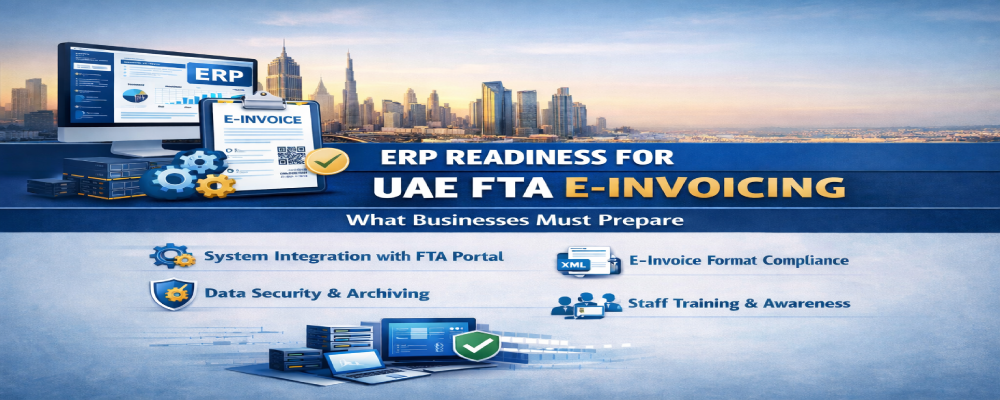
The UAE is transitioning toward structured e-invoicing as part of its broader tax digitization strategy. This shift is designed to improve real-time visibility, standardize invoice reporting, and strengthen compliance across business transactions. It represents a significant change from traditional VAT reporting, where invoices were generated independently and validated later during filing cycles.
Under the new framework, invoices must follow structured formats, include validated tax data, and be traceable across systems. This fundamentally changes how businesses design their invoicing processes and how ERP systems support compliance.
For organizations operating in the UAE, ERP readiness is no longer optional. It becomes the core mechanism through which invoices are created, validated, and recorded. Businesses that rely on manual invoicing or disconnected tools will face increasing operational and compliance challenges.
If you are still understanding the regulatory rollout, it is important to first review the UAE e-Invoicing timeline and compliance deadlines, which explains the phased implementation approach and preparation expectations.
This article focuses on ERP readiness, operational transformation across departments, and the system capabilities required to support UAE FTA e-invoicing.
ERP Systems Will Become the Core of E-Invoicing Compliance
ERP systems evolve from accounting repositories into compliance orchestration layers. Under UAE e-invoicing, invoice generation is no longer a post-transaction activity. It is a real-time validation process where structured data must be verified at the point of creation.
This introduces a fundamental shift from document-based accounting to transaction-led compliance architecture. Every invoice must be derived from operational events such as sales orders, delivery confirmations, or purchase receipts. This ensures that financial data is not manually reconstructed but automatically generated from controlled workflows.
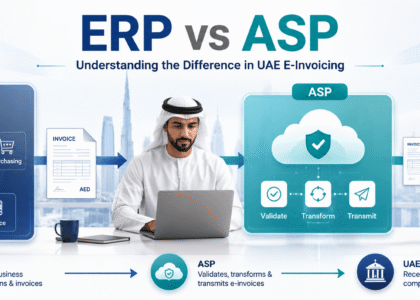
Legacy environments typically rely on disconnected tools across departments. Sales may maintain separate billing records, finance may reconcile invoices independently, and procurement may track vendor invoices in isolation. This fragmentation leads to inconsistencies in tax treatment, duplication of records, and reconciliation delays.
In contrast, an ERP-driven e-invoicing model centralises all transactional data. A single source of truth ensures that every invoice reflects validated operational activity. This creates alignment between revenue recognition, tax reporting, and operational execution.
Legacy Workflow vs E-Invoicing Workflow
Legacy Workflow Characteristics
- Manual invoice creation outside operational systems
- Independent tax selection by users
- Post-facto validation during reporting cycles
- Fragmented departmental records
- High reconciliation effort during audits
E-Invoicing Workflow Characteristics
- Invoice generated directly from approved transactions
- Automated tax logic applied at system level
- Real-time validation of mandatory fields
- Unified data across sales, procurement, and finance
- Continuous audit readiness through system logs
Why Manual and Standalone Invoicing Will No Longer Work
Manual invoicing introduces structural risk in a regulated digital environment. Human-driven processes depend on individual interpretation of tax rules, data entry accuracy, and document handling discipline. This creates variability that is incompatible with structured compliance frameworks.
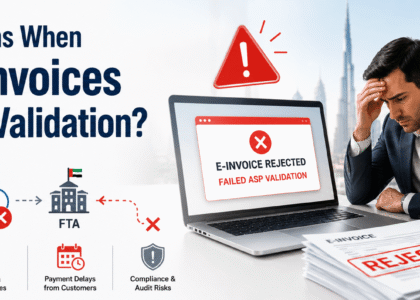
Even minor inconsistencies can create significant compliance exposure. Missing tax identifiers, incorrect TRN formats, or duplicate invoice sequences may not be immediately visible but can trigger validation failures during submission or audits.
Standalone invoicing tools further amplify operational fragmentation. When invoice generation is separated from core ERP data, businesses lose end-to-end visibility. This results in misaligned records between sales contracts, delivery documentation, and financial postings.
The UAE e-invoicing model requires elimination of parallel data streams. Invoice creation must be embedded within operational workflows, ensuring that every financial document originates from validated and traceable business events.
ERP Capabilities Required for UAE E-Invoicing
ERP readiness depends on the system’s ability to enforce structured data governance. This goes beyond accounting functionality and requires deep integration between operational and financial modules.
A compliant ERP environment must support automated tax logic execution. VAT treatment should be derived from predefined rules based on transaction type, customer classification, and supply category rather than manual selection.
Master data integrity becomes a foundational requirement. Customer and vendor records must include validated TRNs, legal entity names, and standardised address formats. Inconsistent master data directly impacts invoice validity and compliance accuracy.
Data Clean-Up Audit Requirements
A structured ERP data readiness assessment typically includes:
- TRN validation across all customer and supplier records
- Standardisation of legal entity naming conventions
- Verification of address formatting against regulatory standards
- Elimination of duplicate vendor and customer profiles
- Alignment of product and service tax classifications
- Correction of missing or incomplete mandatory fields
Invoice sequencing and traceability are equally critical. Each invoice must follow a controlled numbering structure with immutable audit trails that track creation, approval, and posting events.
Integration capability defines operational coherence. ERP systems must synchronise data across CRM, procurement, inventory, and finance modules to ensure consistency in invoice generation.
Operational Impact of UAE E-Invoicing on Business Functions
E-invoicing transforms compliance from a finance-led function into a cross-functional operating model. Invoice accuracy now depends on coordinated data integrity across all business units.
Finance Team Transformation
Finance teams transition from manual validation to governance-led oversight. Their primary responsibility shifts to maintaining system rules, monitoring exceptions, and ensuring configuration accuracy.
Automated systems handle routine calculations and postings. This reduces operational workload and allows finance teams to focus on compliance monitoring and audit readiness.
Audit readiness becomes continuous rather than periodic. ERP systems maintain full lifecycle visibility, including invoice creation timestamps, approvals, and posting logs.
Sales Function Transformation
Sales operations move from document creation to transaction-driven invoicing. Invoices are generated directly from confirmed sales orders rather than manually created documents.
This ensures alignment between pricing, customer data, and tax treatment. It eliminates inconsistencies caused by manual intervention and reduces dispute cycles.
Operational efficiency improves as billing becomes automated. Sales teams focus on deal execution rather than administrative invoice processing.
Procurement Function Transformation
Procurement becomes a compliance-linked operational layer. Vendor onboarding now requires validated tax and entity data before invoice processing can occur.
Invoice matching against purchase orders becomes system-enforced. This ensures financial accuracy and reduces manual reconciliation effort.
Procurement data directly influences tax reporting accuracy. Any inconsistencies in vendor master data can cascade into compliance risks.
Compliance Automation Shift
Compliance moves from reactive review to proactive enforcement. System-level validation ensures mandatory fields and tax rules are enforced at the point of transaction creation.
This significantly reduces post-processing correction cycles. Businesses gain real-time visibility into compliance status across all invoices.
ERP System Capabilities for Structured E-Invoicing
Modern ERP systems must support structured workflows that connect operational data with financial reporting. This includes automated invoice generation, tax rule application, and audit trail management. In the UAE e-invoicing context, this is essential for ensuring that every invoice is compliant at the point of creation rather than corrected later.
Systems must ensure that invoices are generated from validated business transactions rather than manual input. This improves consistency and reduces compliance risk. Audit capabilities must also be embedded so that every transaction is traceable from creation to posting, ensuring transparency during regulatory reviews.
Integration across departments is equally important. ERP systems must unify sales, procurement, inventory, and finance data to ensure consistent invoice generation across the organization.
To evaluate readiness effectively, businesses should focus on a combination of functional and technical capabilities such as:
- Automated invoice generation from sales and purchase transactions
- Built-in tax rule application based on UAE VAT structure
- Controlled invoice sequencing with audit trail visibility
- Cross-module data consistency between finance, sales, and procurement
- Real-time validation of mandatory invoice fields
- Exception handling and approval workflows for compliance control
These capabilities ensure that compliance is embedded into daily operations rather than treated as a separate reporting function.
In practice, businesses often evaluate platforms such as a fully integrated ERP system designed for end-to-end business process automation and compliance control when assessing how structured invoicing, financial reporting, and operational workflows are handled together. The key consideration is not the brand itself but whether the system can maintain structured data flow, automation depth, and audit-ready traceability across departments.
Expected ERP Workflow for UAE E-Invoicing
The structured e-invoicing workflow begins at the transaction level. A sales order or purchase order triggers system-based invoice generation.
Automated validation checks ensure completeness and correctness. The system verifies mandatory fields, applies tax rules, and checks data consistency before approval.
Approval workflows introduce governance where required. Certain transactions may require managerial validation before final posting.
Once approved, invoices are posted and locked. The system generates audit logs that record every stage of the transaction lifecycle.
This ensures that compliance is continuous, traceable, and system-enforced rather than manually managed.
ERP Readiness Checklist for UAE Businesses
ERP readiness must be evaluated across data, system, and process dimensions. This ensures full alignment with structured invoicing requirements.
Master Data Readiness
- Validate all customer and vendor TRNs
- Standardise legal entity naming conventions
- Ensure address consistency across records
- Remove duplicate master records
Tax Configuration Readiness
- Automate VAT classification rules
- Eliminate manual tax selection
- Align tax logic with transaction types
- Validate edge cases such as exemptions and exports
Integration Readiness
- Synchronise ERP with CRM and procurement systems
- Ensure inventory data feeds invoice generation
- Maintain consistent transactional identifiers
Scenario Testing
- Multi-line invoice processing
- Credit note workflows
- Advance payment scenarios
- Export and cross-border transactions
Preparing Before Implementation Deadlines
Early preparation is critical to minimise operational disruption. Organisations that begin transformation early can progressively clean data, refine workflows, and align internal governance structures.
The transition should begin with process mapping. Businesses must identify where manual invoicing dependencies exist and how they interact with current ERP structures.
System configuration testing is equally important. Tax logic, approval workflows, and data validation rules must be tested under real-world scenarios before enforcement begins.
This preparation phase establishes the foundation for technical implementation. These operational structures directly feed into system architecture design, API integration layers, and compliance automation frameworks.
For a deeper technical breakdown of system-level execution, refer to UAE FTA e-invoicing technical implementation and ERP integration architecture, which explains how regulatory rules translate into structured digital workflows across enterprise systems.
Common Questions on ERP Readiness and UAE E-Invoicing Compliance
1. What is ERP readiness for UAE FTA e-invoicing?
ERP readiness refers to the ability of a business system to generate, validate, and store invoices in a structured format that complies with UAE FTA e-invoicing requirements. It ensures that financial transactions are processed through automated and traceable workflows instead of manual invoicing methods.
2. Why is ERP important for UAE e-invoicing compliance?
ERP systems act as the central compliance engine by connecting sales, procurement, inventory, and finance data. They ensure invoices are generated from validated transactions, apply correct tax rules, and maintain audit-ready records required for regulatory reporting.
3. Can businesses use manual invoicing for UAE e-invoicing?
Manual invoicing is not suitable for structured e-invoicing frameworks. It increases the risk of errors, missing tax data, and inconsistent records. UAE e-invoicing requires system-generated invoices with standardized fields and real-time validation.
4. What ERP features are required for UAE e-invoicing?
Key ERP features include automated invoice generation, VAT-compliant tax calculation, audit trail tracking, cross-department integration, controlled invoice sequencing, and real-time validation of mandatory invoice fields.
5. How does ERP improve invoice accuracy and compliance?
ERP systems reduce manual data entry by generating invoices directly from business transactions. This ensures consistency, minimizes human error, and provides a complete audit trail for every financial entry, improving compliance accuracy.
6. Which business functions are affected by UAE e-invoicing?
UAE e-invoicing impacts finance, sales, procurement, and compliance teams. Finance teams focus on governance, sales teams work with automated invoice generation, procurement ensures vendor invoice alignment, and compliance becomes system-driven.
7. What should businesses do before implementing UAE e-invoicing?
Businesses should evaluate ERP readiness by checking data quality, tax configuration, system integration, and workflow automation. Early preparation helps ensure smooth transition and reduces operational disruption during implementation.